A Death in the Gunj – The Notebook Scene


In some films, there is one scene, moment, or beat which summarizes the complete story in a nutshell much before the climax (sometimes even interval). If not the ‘complete’ story, it manages to provide enough information of how the story is going to unfold itself in hindsight. Often the writer does it subconsciously, but the ones who do it on purpose, may just be showing his or her brilliance as a writer. Us in the Kaleidoscope’s focus here is on the debutante writer Konkona Sen Sharma’s A death in the Gunj.

Released in 2016, ‘A death in the Gunj’ marked the first work of Konkona Sen Sharma in the field of writing-directing. The drama/thriller film caters to the ensemble of powerful actors. It won a Filmfare for best cinematography and costume, IIFA Award for best debutante director, Jio MAIMI Film Festival for best director, New York Indian Film Festival for best director, Mosiac International South Asian Film Festival for best fiction film. It was also nominated under several categories and screened at Toronto International Film Festivals 2016. However, this analysis is focusing more on ‘the notebook scene’.

SHUTU is on the study table, scribbling in his notebook, when TANI enters scene. This takes place within the first seventeen minutes of the runtime. I call it – The Notebook Scene. The writer chooses this scene to reveal her characters’ nature in the film. SHUTU’s interaction with TANI is meant more to be an interaction between SHUTU and the audience. Once TANI enters the room, we begin to see the scene from her perspective, which gives writer greater control over what to feed us.
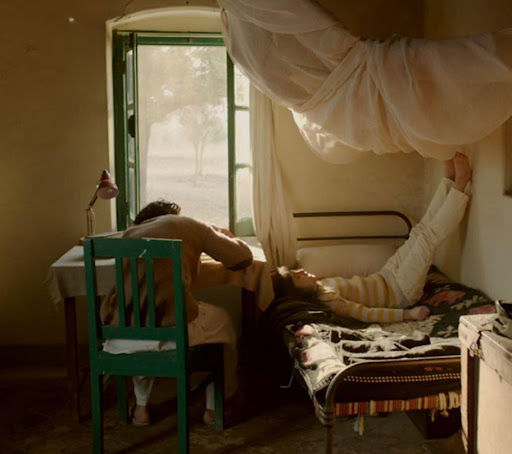
Our scrupulous attention is on the three major take-away from the notebook, in its given order of appearance.
First, the sketch of the frog. Second, the frozen moth. Third, list of words starting with the letter ‘E’
The Sketch of the Frog
Soon after the sketch of the frog, both SHUTU and TANI debates on ‘who does the frog look like between them’. TANI wins the debate, or rather, SHUTU does not counter the eight-year old’s logic. Now, SHUTU may lack any resemblance to the frog in literal terms, but metaphorically, he just might be one.

In the preceding scene, BONNIE encounters a frog in the bathroom. She distinctively expresses her fear and disgust towards it. Like the frog, SHUTU is also an outsider to certain members of the family. We can point out to the emotional distance between them and SHUTU as we move forward in the story. SHUTU remains isolated (but mostly with TANI) in all the family scenes – the picnic, new year party, and even during their game of kabaddi (although, he was invited to play later to balance the strength of team members). Later, when TANI was lost and then found, the family did not even realize SHUTU was missing until the servant pointed it out. His overall presence seems to be acquiring an unwelcomed space, no more than a frog trespassing into the bathroom.
The Frozen Moth
SHUTU turns over the pages of his notebook to show TANI a dead moth. SHUTU carefully handles the moth as he passes it over to TANI. In the rest of the film thereon, SHUTU’s empathy and compassion towards the dead makes him stand out. In his trip to the graveyard with MIMI, he was against the idea of eating the cake which was meant for the grave of the six-year-old Elizabeth Curney. Even during their interaction with the spirits, it was SHUTU who wishes to opt out of it. He says that calling upon the spirits causes them pain. Does it mean he believes there is rest after death? The symbolism of a moth has a neglected contribution towards this characteristic of SHUTU.

A moth holds greater significance in the Native American Culture. Mainly in the Blackfoot Confederacy, which is a band of four nations speaking the language ‘Blackfoot’. To them, a moth represents sleep, dreams, souls of the dead, and even rebirth. Moths are also called ‘night butterflies’ for they are drawn to light. When taken this into consideration, it becomes clear why SHUTU visits McCluskiegunge with NANDU’s family. When the family comes together, they create an energy that is positive and bright. SHUTU, who is going through a trauma, is the ‘moth’ that is drawn towards this energy.

The moth also represents the spirits of the ancestors and the belief in ‘resurrection’ after death. Is this the reason why we see his soul after death? Or, is he still drawn towards the energy of the family? Or, is he simply waiting for VIKRAM and NANDU to perform another ritual to interact with the spirits? In my opinion, his soul finds the answer to our first question which is – There is no rest after death. It is an open ending – a climax which most of writers enjoy throwing at the audience, be it Konkona Sen Sharma or Christopher Nolan. However, what we do know is that writer clearly attempts to hint her audience towards several symbolisms hidden in notebook. I can say this with confidence because in Celtic mythology, a moth inside the house means there will be a death in the family. So the moment SHUTU (the moth) enters McCluskiegunge, it was certain that there will be ‘a death in the Gunj’.
The Words Starting with ‘E’
We are about to dissect the third and final reveal. The notebook scene ends with TANI and the viewers learning new words that start with the letter ‘E’. It is not just a list of words, but a conduit for the Konkona Sen Sharma to show her talent as a writer.

There are in total 31 words in his notebook, but none of them is random. Most of it directs toward SHUTU himself, while some of it represents other characters too.

NANDU – He is the only one in the group who acts responsible. He expresses a firm knowledge of driving lessons, or mothering lessons during his contentious debate with BONNIE, or how SHUTU should be taking care of his mother. This trait of the character often surfaces in different scenes, which is why the word that firmly represents him is ‘Erudite’.

VIKRAM – He is the exuberant element in the group who seems to be enjoying life. It is true, he does act like a twenty-three-year-old who always wishes to win his arguments. However, VIKRAM is also responsible to initiate spark among other characters and scenes. The words which should represent him are ‘Effervescent’, ‘Eristic’ and ‘Elan’.

MIMI – She is foreign to the family like SHUTU, but unlike him, her chemistry with other members is far better. This blithe character brings in a sense of recklessness just as much as maturity and charm just as much as sensuality. The words ‘Esoteric’, ‘Enigmatic’, ‘Eros’, and ‘Erotica’ should fit well here.

Other words like ‘Ethos’, ‘Ethnicity’ and ‘Euphony’ can point us towards the characteristics of MANJARI’s community. The circular dance around the burning flames is a spiritual movement in early mythologies, and so is their regional song/chant, which is but pleasing. One can also find roots of ethnicity in PURNIMA (VIKRAM’s wife) as well, who appears to be sporting in traditional ornaments.

The animals shown or mentioned in the story are, in total, five- frog, moth, tortoise, puppy, and ant. All the animals have lasted for a short period in the lives of the characters. The pet tortoise (Haridas) was left behind. The affection towards the puppy turns into contempt. The frog was forgotten, and we see it back in bathroom. The ant was killed to show the change in SHUTU – from compassionate to rage. Then, the moth – an insect with naturally a short life span. The words representing them are ‘Evanescent’ and ‘Ephemeral’.
Finally, let's come back to SHUTU, the character which connects with most of the words from the list.

I will write a short sketch on SHUTU based on how the film portrays him. Then leave you with the words which, according to me, best fits in his case.
Shutu is a twenty-three old boy who is in trauma due his father’s death. He is bright boy, but the tragedy pushes him into failing his exams. Shutu joins his cousin for a vacation instead of returning to his mother after college. He is mostly quiet and consumed in his own space, due to which he is cut out from the family. The lack of communication has made it difficult for the rest of the family to understand his mindset. Shutu is seen helping the family in ways that of a housekeeper/baby-sitter. He finds shelter in the family, but not the emotional comfort. Shutu develops a connection with Mimi. However, Mimi treats him as worthless soon after finding out about his failure. He loses the enthusiasm which he developed because of the connection. As the story proceeds, Shutu realizes he cannot escape anymore but to face the responsibilities which once were his father’s. Naturally succumbing into depression, causing him to end his life. But will his soul rest in peace?
Now, see if the following ‘E’ words from the notebook fit to SHUTU.
Esoteric – understood by less no. of people.
Evanescent – soon passing out of sight/existence/memory.
Entropy – ending up in disorder.
Eschew – to give up something.
Ennui – lacking energy/enthusiasm or dissatisfaction.
Enigmatic – mysterious or difficult to be understood.
Ethereal – delicate, light, out of the world.
Echelon – ranking in a society.
Ephemeral – lasting for short a time.
Epiphany – a moment of sudden and great revelation or realization.
‘A death in the Gunj’ remains one of my favorite films because of its flawless writing. The film shows us how a character is absorbed by trauma without ever letting the character even speak of it even once. Instead, this trauma narrated through the contrast created by placing him in a positive space. In cinema, stories which originate from writers’ own past experiences gives them a better control over the narration. ‘A death in the Gunj’ partially draws from life events of the Konkona Sen Sharma, which makes her characters livelier. They all have depth and a distinct identity of their own, owing to stark performances of the actors. I suggest you watch the film once again after reading our analysis and notice what you missed the first/last time.
Noter – There are more words which remain unmentioned in the analysis. I shall leave them below for you to find a connection with the story. There is one word whose visibility is unclear, and one whose spelling in the notebook is incorrect. EULOGY – ERRATA – EGHNOLOGY (correct spelling: ENTHOLOGY) – EUPHEMISM – ERGONOMICS – ETHOS – ERGO – EGALITARIAN – EPONYMOUS – ECLECTIC – ELLIPTICAL – EPIPHANY – ECRY


Comments